
Informal Underwriting in Impaired-Risk Life Insurance: What It Can and Cannot Do — A Complete Guide for Agents and Consumers
- Philippe Deray

- Nov 24
- 6 min read
When it comes to impaired-risk life insurance, almost every case begins the same way: a client with a complicated medical history reaches out, hoping they can be approved but afraid they won’t be. They often don't know their exact diagnosis, they can’t remember dates, they forget test results, and they certainly don’t want to chase down medical records. And yet, an agent must somehow determine whether a formal application will result in an approval—or a decline that gets reported to the MIB and affects every future attempt.
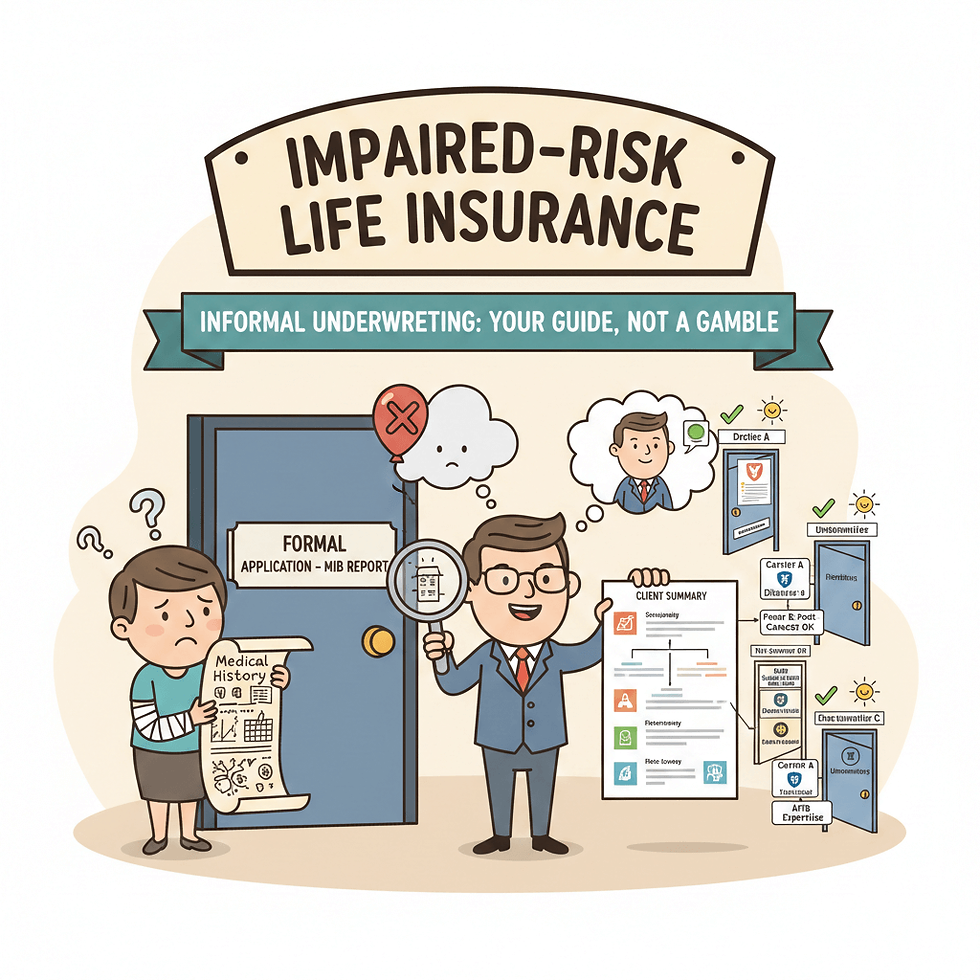
To bridge this gap, the industry uses informal underwriting—a system where the agent presents a case summary to multiple carriers without triggering an MIB report. But while informals can absolutely prevent declines and give direction, they also have limitations. The effectiveness depends heavily on how the informal is done, the quality of information collected, and the underwriter’s ability to interpret incomplete data.
This article breaks down the advantages, downsides, best practices, typical pitfalls, and the essential questions agents should ask in order to use informals as a tool—not a gamble. It also examines what happens if a client has already been declined by another agent and how that impacts future applications.
Why Informal Underwriting Exists
Impaired-risk applicants are unpredictable. Medical histories vary widely, and small details can determine whether a carrier:
Approves
Rates
Postpones
Declines
If the client goes straight into a formal application and gets declined, that decline appears on the MIB, often for seven years, and will influence other underwriters. The formal decline becomes a permanent handicap.
Informal underwriting avoids this by getting preliminary carrier feedback without creating an application record.
But while informals were designed to solve problems, they also come with new challenges.
The Core Problem: Clients Don’t Know Their Own Medical History
For impaired risk, this is the #1 reality agents must accept.
Most people cannot accurately answer:
Dates of diagnosis
Medications (beyond names)
Dosages
Changes in treatment
Exact test results
Hospital records
Follow-up recommendations
Whether a condition is “controlled” or not
They rarely understand cardiology terminology, oncology staging, A1C interpretation, or what their stress test actually showed. They often minimize or unintentionally misrepresent the seriousness of their issues.
This creates a dilemma:
If an informal is based on poor information, the underwriter’s response may be meaningless.
So the question becomes: Is an informal still worth doing?
Absolutely—but only if structured properly.
The Advantages of Informal Inquiries
1. Avoids MIB declines
This is the core benefit. If a carrier would likely decline based on the information provided, you simply never file formally.
2. Helps identify the right carrier
Different insurers have different appetites. One may decline AFib, while another offers Standard if controlled. One may postpone after cancer, while another accepts at Table 4.
3. Helps the agent set client expectations
Clients need realistic expectations, and informals give you that:
Possible rating
Range of premiums
Which carriers are viable
Whether medical records are essential
4. Minimizes wasted time
A formal decline wastes everyone’s time and stalls the client’s progress. A quick informal keeps the process moving.
5. Many carriers will order medical records voluntarily
This is a major, little-known advantage. Some insurers are willing to order APS records during an informal—without an official application—so the client doesn’t have to get them.
6. The informal is often 70–80% accurate
For stable, well-known impairments like diabetes, sleep apnea, AFib, high BMI, and controlled hypertension, informal estimates are usually very close to formal results.
The Downsides and Limitations
1. Information is often incomplete or inaccurate
Underwriters rely partially on assumptions when details are missing. This can lead to overly conservative decisions.
2. Some impairments require medical records—period
Certain cases simply cannot be informally underwritten without APS:
Cancer
Heart surgery
Organ transplants
Complex arrhythmias
Liver disease
Kidney disease
Neurological conditions
3. Multiple informals can fatigue underwriters
If the case is poorly summarized, scattered, or unprofessional, underwriters may feel the agent is inexperienced and base their answer on limited information.
4. Clients tend to procrastinate
If the informal requires the client to chase down medical records, almost all of them will stall, delay, or disappear.
5. Even informals can take time
Not as long as formals, but still long enough that some clients lose interest.
The Real Secret: The Quality of the Agent Summary Determines Success
A good informal cover sheet can compensate for most client knowledge gaps.
A bad or sloppy summary almost always results in:
Declines
“Need more information”
Assumptions
Higher ratings than necessary
The underwriter needs:
Key facts
Clear timelines
Medication lists
Control status
Stability
Lifestyle positives
Not everything—just what matters.
A properly structured informal summary can be as effective as medical records for many impairments.
The Most Important Questions to Ask Clients (Universal Core Questions)
These are the questions that must be asked for every impaired risk case, no matter the condition. They give an underwriter 80% of the picture:
1. Height and Weight
Sets the BMI rating, which influences every file.
2. Medications You Take
This alone often tells the underwriter the diagnosis and severity.
3. Any hospitalizations in the last 5 years?
YES/NO is enough. If yes → approximate date + reason.
4. Any major diagnoses?
You do NOT need detail—just identify the impairment.
5. Any recent abnormal tests?
Stress test, echo, CT scan, labs, A1C, etc.
6. Tobacco or vaping history
(current and past)
7. Alcohol intake
A surprisingly important factor in liver, heart, and metabolic conditions.
8. Family history of early heart disease or cancer
Only early deaths matter.
9. Any surgeries or procedures?
Especially:
Cardiac
Bariatric
Cancer-related
10. Follow-up compliance
Underwriters love stability.
Condition-Specific Add-On Questions (Examples)
Atrial Fibrillation
Any blackouts or syncope?
Any palpitations?
Last cardiology visit?
Echocardiogram done?
Any ablation?
Controlled with meds?
Diabetes
Last A1C?
Medication type?
Any neuropathy, nephropathy, or retinopathy?
Cancer
Type
Stage
Date of last treatment
Any recurrence?
High Blood Pressure
Controlled or uncontrolled?
Any cardiac complications?
The point is: You don’t need perfect information—just enough for the underwriter to evaluate the risk directionally.
What If the Client Has Already Been Declined?
This is a critical scenario. Many impaired-risk clients come to you after another agent has submitted a formal application and been declined. This complicates things, but it does not make approval impossible.
Key points:
The MIB record exists A previous decline is usually reported to the MIB. Underwriters will see a code indicating a prior decline.
It doesn’t automatically kill the application Carriers still evaluate the medical facts independently. A decline from one company or agent does not mean all carriers will decline.
Informals can still help Even after a prior decline, submitting an informal to a more lenient insurer allows you to:
Determine which carriers might approve
Understand likely ratings
Avoid unnecessary formal applications with other carriers
The previous decline adds friction Underwriters will scrutinize the file more carefully. This is why having a professional, well-structured informal summary is even more critical.
Client management is key Explain that a prior decline is not a dead end, but that results may vary depending on the carrier and the accuracy of the submitted information.
In short: previous declines make informal underwriting more valuable, not less. It allows you to avoid further declines while exploring viable carriers.
Will Informals Truly Help Avoid Declines?
Yes—but with a huge caveat:
The informal only works if you do NOT file a formal application until a carrier gives a favorable informal opinion.
This sounds obvious, but many agents jump too quickly into formal apps because the client is impatient. That is the real danger.
A clean MIB file is more valuable than speed.
Are Informals a Waste of Time?
Only if:
They’re done with poor information
They’re sent to the wrong carriers
The client refuses to cooperate
The case is too complex for a summary
The agent expects an exact rating instead of general direction
Otherwise, informals save:
Time
Money
Declines
Client frustration
And they help close more business.
The Final Verdict: The Real Role of Informal Underwriting
Informal underwriting is not perfect. It is not binding. It does not replace medical records in every case.
But in impaired-risk life insurance, it is the most important tool for:
Protecting the client’s MIB history
Identifying which carriers have an appetite for the risk
Preventing wasted applications
Establishing client trust
Speeding up approval for straightforward impairments
Giving realistic expectations early
Avoiding further declines after a previous denial
When done well—with structured questions, organized notes, and a professional summary—informals dramatically increase approval rates while reducing declines.
When done poorly, they can mislead both the agent and the client.
But the method itself is sound. It just requires discipline, structure, and consistent execution.
If you want, I can also create:
A fillable informal questionnaire
A template underwriter summary
A phone script for obtaining client medical details
A client-facing explanation of why informals matter
All tailored specifically for impaired-risk life insurance.
Life Insurance Disclaimer
Disclaimer: This article is for informational purposes only and is not legal, financial, or insurance advice. Life insurance needs and products vary by individual, state, and insurer. Policies may involve fees, costs, and limitations. Some policies include a cash value component that can grow over time, and certain strategies may allow for accumulation beyond basic protection. Results are not guaranteed and may vary by policy, insurer, and state. Consult a licensed insurance professional before making any life insurance decisions.
#LifeInsurance #ImpairedRisk #UnderwritingTips #InsuranceAgents #PolicyApproval #MIBProtection #HighRiskInsurance #InsuranceStrategy #ClientGuidance #InsuranceInsights


Comments